
In a Q&A article, the Pension Boards outlines the benefits and risks of investing in Target Date Funds and shares why you, the member, should take advantage of the Pension Boards’ Target Annuitization Date (TAD) Funds. The TAD Funds automatically reallocate your investments in line with your anticipated annuitization date, and when you annuitize, they are converted to a defined benefit annuity – an option not provided through other plans in the financial services marketplace. Click here to read the article.
Each TAD Fund seeks levels of capital appreciation, principal preservation and current income that are consistent with its asset allocation at a particular time. A TAD Fund with a relatively long time horizon (defined as the time before a Fund’s target date) will have more emphasis on seeking capital appreciation, whereas a TAD Fund with a relatively short time horizon will have more emphasis on income and principal preservation.
These Funds are suitable for investors who plan to annuitize in or around the year of a specific Fund, who want a portfolio that automatically becomes more conservative as time passes and who do not have the time, interest or inclination to rebalance their portfolios as their annuitization date approaches.
The TAD Funds are “funds of funds” that invest in The Pension Boards’ Equity, Bond and Stable Value Funds and thus invest in the securities permitted in those funds.
Manager(s) - click here for list of Fund managers
To access another Fund profile, click Fund name below.
The Equity Fund seeks to provide long-term growth of principal and income.
This Fund is suitable for investors who are willing to accept a greater degree of principal and income volatility for some portion of their assets than will be typical of the Stable Value Fund, the Bond Fund, the Sustainable Balanced Fund or the Target Annuitization Date Funds, in the pursuit of long-term growth. Over long periods of time, the return to investors in this Fund should exceed the return to investors in the other Funds. Over shorter periods of time, however, returns to investors in this Fund could be less than the returns to investors in the other Funds, and at times the returns from this Fund will be negative.
The Fund invests primarily in a broadly diversified portfolio of domestic and international equity securities further diversified by market capitalization, sector, and style. Alternative assets are permitted up to limits established by the Investment Committee, subject to approval by the Investment Committee. Alternatives may include private equity (buyouts, venture capital, distressed), real assets (real estate, timber and other natural resource based assets) and hedge fund strategies such as arbitrage, relative value , directional, and event-driven strategies. Futures guidelines are provided in the Investment Guidelines.
Manager(s) - click here for list of Fund managers
To access another Fund profile, click on Fund name below.
The Equity Fund seeks to provide long-term growth of principal and income.
This Fund is suitable for investors who are willing to accept a greater degree of principal and income volatility for some portion of their assets than will be typical of the Stable Value Fund, the Bond Fund, the Balanced Fund or the Target Annuitization Date Funds, in the pursuit of long-term growth. Over long periods of time, the return to investors in this Fund should exceed the return to investors in the other Funds. Over shorter periods of time, however, returns to investors in this Fund could be less than the returns to investors in the other Funds, and at times the returns from this Fund will be negative.
The Fund invests primarily in a broadly diversified portfolio of domestic and international equity securities further diversified by market capitalization, sector, and style. Alternative assets are permitted up to limits established by the Investment Committee, subject to approval by the Investment Committee. Alternatives may include private equity (buyouts, venture capital, distressed), real assets (real estate, timber and other natural resource based assets) and hedge fund strategies such as arbitrage, relative value , directional, and event-driven strategies. Futures guidelines are provided in the Investment Guidelines.
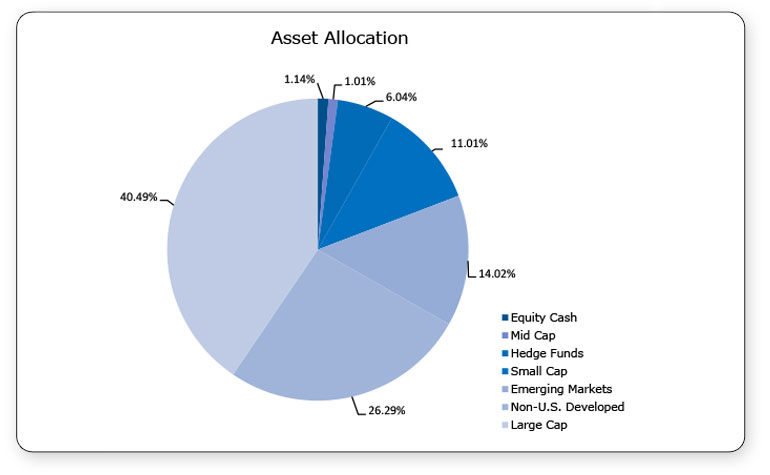
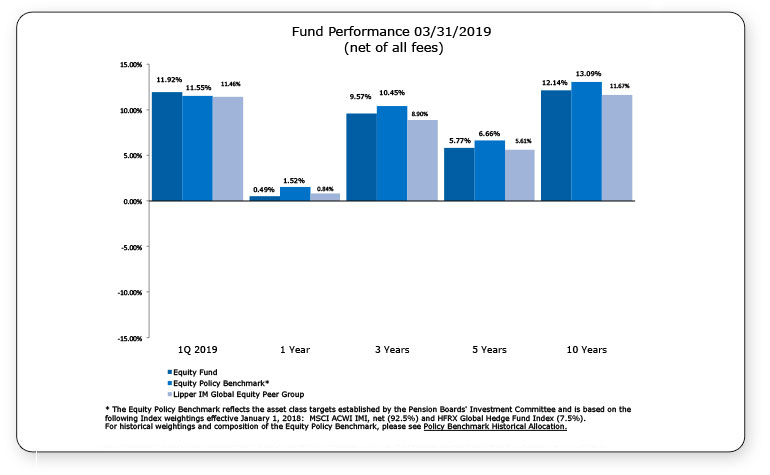
Click on the thumbnail to view chart.
Manager(s) - click here for list of Fund managers
Fee Disclosures
Historical Policy Benchmark
To access another Fund profile, click on Fund name below.
The Sustainable Balanced Fund seeks to provide long-term growth of principal and income.
This Fund is suitable for investors who are willing to accept a greater degree of short-term principal and income volatility for a portion of their assets than will be typical of the Stable Value Fund or the Bond Fund, in pursuit of long-term growth of principal and income. This Fund, however, will typically be less volatile than the Equity Fund and the two longer dated Target Annuitization Date Funds. This Fund is also suitable for investors seeking a fund in which The Pension Boards will manage the allocation of asset classes approved by the Investment Committee. Under normal conditions, between 40% and 70% of the Fund’s assets will be invested in stocks, 30% to 60% will be invested in bonds and 0% to 10% will be invested in alternative assets.
Over long periods of time the return to investors in this Fund should exceed the return to investors in the Stable Value Fund, the Bond Fund, and the two shorter dated Target Annuitization Date Funds but it should fall short of the return to investors in the Equity Fund and two longer dated Target Annuitization Date Funds. However, over shorter periods of time, returns to investors in this Fund could be less than the returns to investors in the other Funds, and at times they may be negative.
The Fund achieves broad diversification by investing in units of the Bond and Equity Funds. Alternative assets are permitted up to limits established by the Investment Committee and subject to Investment Committee approval and may include private equity (buyouts, venture capital and debt including distressed), real assets (real estate, timber, natural resource based assets) and hedge fund strategies (which may include arbitrage, relative value, directional and event-driven strategies). Futures guidelines are provided in The Investment Guidelines.
Manager(s) - click here for list of Fund managers
To access another Fund profile, click on Fund name below.
The World Selection Fund (WSIF) (formerly known as the Global Sustainability Index Fund) seeks to provide long-term growth of principal and income. This Fund is suitable for investors who are willing to accept a greater degree of principal and income volatility for some portion of their assets than will be typical of the Stable Value Fund, the Bond Fund, the Sustainable Balanced Fund or the Target Annuitization Date Funds, in the pursuit of long-term growth. Over long periods of time, the return to investors in this Fund should exceed the return to investors in the other Funds. Over shorter periods of time, however, returns to investors in this Fund could be less than the returns to investors in the other Funds, and at times the returns from this Fund will be negative.
The Fund invests primarily in a broadly diversified portfolio of domestic and international equity securities further diversified by market capitalization, sector, and style. In addition, WSIF considers ESG factors (environmental, social and governance) in portfolio construction. The Fund will be indexed to the MSCI World ESG Index, which it will seek to replicate. In addition to the environment, WSIF is sensitive to social issues involving human rights and governance issues involving the leadership of the companies in which we invest on your behalf.
Managers - click here for list of fund manager(s)
To access another Fund profile, click on Fund name below.
The Bond Fund seeks to provide maximum total return through active management of a broadly diversified portfolio of fixed income securities. Principal and income in this Fund will fluctuate with changing market conditions.
The Bond Fund is suitable for investors willing to sacrifice stability of principal for greater return for some portion of their assets.
Over long periods of time the return to investors in this Fund should exceed the return to investors in the Stable Value Fund, but it is likely to fall short of the return to investors in the Sustainable Balanced, the Equity or Target Annuitization Date Funds. However, over shorter periods of time, the reverse could be true. At times the total return to investors in this Fund may be negative.
This Fund is a broadly diversified, actively-managed portfolio that invests primarily in U.S. Treasury securities, government agency bonds, corporate bonds, mortgage-backed and asset-backed securities, U.S. dollar-denominated foreign bonds, and cash equivalents. The Fund may also invest in senior secured bank loans, high yield bonds, non-investment grade and emerging market debt securities denominated in U.S. dollar or any other currency within established limits. An average maturity of 5 to 10 years is normally maintained in this Fund. Predominantly fixed income-based alternative assets may be approved by the Investment Committee. Alternative investments may result in a small percentage of assets in the fund that have non-fixed income characteristics.
Manager(s) - click here for list of Fund managers
To access another Fund profile, click on Fund name below.
The Stable Value Fund seeks to preserve both invested principal and earned interest, to earn a stable fixed income yield and to provide liquidity for member-directed disbursements.
Stable value funds are suitable for investors who are risk-averse and who want to safeguard the principal value of their accumulated savings while earning an attractive rate of interest. The Fund is suitable for investors who are looking for liquidity and stability of principal and earned interest, perhaps in anticipation of annuitizing their Accumulation Account balances, or to balance by using stable value in a portfolio with other more aggressive investments. Past performance is no guarantee of future results, but historically, Stable Value Funds have preserved principal and have accumulated interest throughout all interest rate cycles. The crediting rate of the Fund will fluctuate with changing interest rates.
Over long periods of time, the return to investors in this Fund will most likely fall short of the return to investors in any of the other Funds. However, Over shorter periods of time, the return to investors in this Fund could exceed the return to investors in the other Funds.
The Fund invests in high-quality fixed-income investments that may include guaranteed investment contracts issued by insurance companies, bank investment contracts, U.S. Treasuries and its agencies, asset-backed and mortgage backed securities, corporate bonds, and cash and cash equivalents such as Treasury Bills and commercial paper. Investment maturities are short to intermediate term (10 years or less).
Manager(s) - click here for list of fund managers
To access another Fund profile, click on Fund name below.